



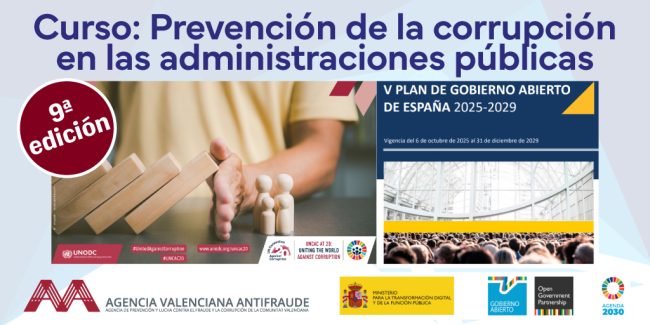
The INAP and the Valencian Anti-Fraud Agency consolidate their collaboration in the promotion of public integrity with the 9th edition of their course on corruption prevention
Valencia, 22 June 2026.- The National Institute of Public Administration (INAP) and the Valencian Anti-Fraud Agency (AVAF) have concluded the 9th edition of the course Prevention of Corruption in Public Administration, held from 25 May to 22 June 2026. This call has once again demonstrated the great interest aroused by the subject, registering a demand of 534 registered people, of which 100 participants were selected to cover the available places.
It is worth highlighting the change in the final test of the training activity, in which the students have expressed what in their opposition were the most important advances and challenges in the integrity systems of their organizations. In this regard, they have highlighted, among other issues, the following:
- Regulatory implementation: Almost 100% of the participants recognize that the Internal Information Systems (SII) are already in place after the entry into force of Law 2/2023. However, in many cases it is highlighted that the preventive mechanisms of integrity policies, such as codes of conduct or gift policies, do not exist as their own documents or are poorly developed, and are generically integrated into anti-fraud plans or are limited to mere references to TREBEP.
- Critical points in accessibility: One of the most repeated aspects is the lack of visibility of the reporting channels. Many students have insisted that they are “hidden” in footnotes or transparency portals that are difficult to access. In addition, webcasting of management procedures is spotty and often poorly explained.
- Transparency and anonymity: While anonymity is mostly guaranteed through advanced technological platforms (such as Xperta or Globaleaks), students express doubts about the functioning of their organisations’ ethics or anti-fraud committees.
- Identification of the external channel of information: This is the issue with the least by the participants in the course. In general, it is stated that there is a fairly widespread confusion in the information provided by the institutions, detecting broken links or links that do not correctly refer the whistleblower to the independent protection authorities.
The participants agreed that the public administration still suffers from a lack of promotion of an ethical culture and preventive strategies. A lack of knowledge of integrity systems on the part of personnel has been underlined, which makes it necessary to provide hours of training and awareness so that public servants can incorporate these integrity tools as their own in their daily work.
The course was attended by a representation of public employees from the state and local administration and autonomous bodies. Among the participants are professionals from ministries (Inclusion, Social Security and Migration; Agriculture, Fisheries and Food; Ecological Transition and the Demographic, Interior or Defence Challenge), the Tax Agency, the CSIC, the Court of Auditors, the Civil Guard, the Air and Space Force, as well as cultural and scientific institutions such as the Cervantes Institute, the National Library of Spain or INTA. Likewise, there has been representation from universities (La Rioja, Jaén, Valladolid, Polytechnic of Cartagena, Valencia, Alicante) and local entities such as the City Council of Murcia and the Provincial Council of Lugo, among others.
This training action reinforces the collaboration between INAP and AVAF, strategically aligning with Commitment 3 of Spain’s V Open Government Plan (Integrity and Accountability) and SDG 16 of the United Nations (Peace, Justice and Strong Institutions).