


ISTEC and the Valencian Anti-Fraud Agency sign a collaboration agreement to develop a framework for integrity and public ethics

Burjassot, October 25, 2022.- The commercial company Infraestructures i Serveis de Telecomunicacions i Certificació (ISTEC), pending the Ministry of Finance and Economic Model of the Generalitat Valenciana, and the Valencian Anti-Fraud Agency have signed a collaboration agreement for the implementation of activities to prevent fraud and corruption and the promotion of ethics and public integrity.


The agreement was signed by the managing director of ISTEC, Juan Alegre Sanahuja, and by the director of the Agency, Joan Llinares, atISTEC’s facilities in Burjassot. This public company constitutes as a telecommunications operator to provide electronic communications services to operators controlled by public administrations .


Among the actions contemplated by the agreement is to comply with the requirements of the European Directive 2019/1937 on the protection of persons who report on infringements of Union Law, with the recognition by ISTEC as an external channel of their complaints the Complaints Mailbox of the Agency and adheres to it ; as well as the Order of the Ministry of Finance and Public Function 1030 of September 29, 2021 on the obligation to equip itself with Anti-Fraud Plans.


In order for the Complaint Mailbox of the Agency to act as an external channel of denunciations of ISTEC thisentity undertakes to include in a visible place within its website, or any other support it deems appropriate, the link of the AVAF Complaints Mailbox together with the clear and precise information about its function and purpose.


In addition to the external whistleblowing channel, the Agency will collaborate with ISTEC for the implementation of its internal complaints channel, in order to comply with other requirements of the European Directive.


ISTEC also undertakes to approve its own Integrity Plan that will have the collaboration, assistance and exchange of information by the Agency. This Integrity Plan shall contain an institutional declaration of integrity; incorporating institutional integrity into strategic planning; the regulation and management of conflicts of interest; the training of ISTEC personnel in integrity or the promotion and dissemination of the culture of ethics and public integrity, among other issues.


The general director of Infrastructures i Serveis de Telecomunicacions i Certificació (ISTEC), Juan alegre Sanahuja, has highlighted “the importance of having the knowledge and means of the AVAF to develop a solid social structure of integrity and fight against fraud and thereby strengthen the confidence of society in the proper use and management of public funds by the public sector”.


For his part, the director of the Agency, Joan Llinares, has declared that “the signing of this agreement with ISTEC is added to the one we reached a few months ago with VAERSA and both show how the Valencian instrumental public sector wants to provide public integrity frameworks in the exercise of its functions which will result in the creation of higher levels of ethics and public integrity that are a guarantee for the all citizens”.
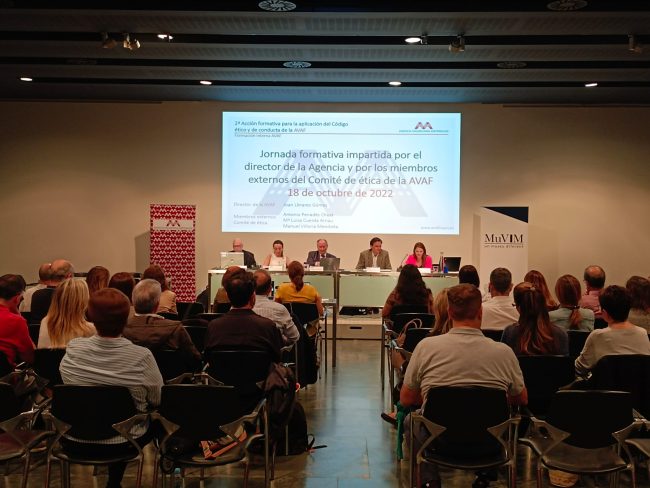
The professor of Political Science, Manuel Villoria, joins the Ethics Committee of the Valencian Anti-Fraud Agency

Valencia, October 27, 2022.- The professor of Political Science and Administration of the Rey Juan Carlos University, Manuel Villoria, has been registered as anexternal member of the Ethics Committee of the Valencian Anti-Fraud Agency.


This incorporation completes the maximum number of members that this Committee can have and is made up of three people external to the AVAF and one person chosen from among the Agency’s own staff.


Antonio Penadés and Mª Luisa Cuerda were elected as external members of the Committee in February and Manuel Villoria is now incorporated. All three have been appointedfor a period of four years on the proposal of the AVAF Board of Directors.


The person chosen from among the Agency’s own staff was chosen by vote and has fallen to Amparo Martí Puertes, head of the Support and Expertise Unit of the Research area.


In the case of Antonio Penadés Chust is also a member of the Agency’s Participation Council, thus complying with the provisions of article 35 of the Code of Ethics and Conduct, in sections 1 and 2, which states that the Committee will be made up of people outside the AVAF, one of them being at least a member of the Consell de Participacion.


For her part, Mª Luisa Cuerda Arnau is Professor of Criminal Law specializing in fundamental rights at the Jaume I University of Castellón while Manuel Villoria is Professor of Political Science and Administration at the Rey Juan Carlos University.


With the appointments of these people, Article 6.3 is also complied with, which states that the Committee will be composed of a maximum of four people, three of them external from among professionals of recognized prestige in the field of the defense of public ethics, integrity and transparency.


On February 10, 2022, the Valencian Anti-Fraud Agency approved the Code of Ethics and Conduct for its staff that includes the ethical principles and values of good governance that must inform all the actions of the Agency and will regulate the impartiality, confidentiality and conduct that staff must necessarily observe, especially with regard to conflict of interest.


Chapter IV of the Code provides for the establishment of an Ethics Committee to ensure the proper application of the Code and to assist in resolving any disputes that may arise. Once the people who will be part of this Ethics Committee were appointed, it was constituted last week.
Among the functions of the Ethics Committee are to ensure compliance with the Code of Ethics and Conduct: to promote its dissemination and internalization by the recipients; inform about the doubts or queries that may arise in the cases of interpretation of the Code; deal with the internal complaints referred to in the Code; make recommendations on non-compliance with the Code or produce an annual report explaining the degree of compliance with the Code.


The Code of Ethics is available on the Agency’s website and can be accessed through this link:

https://dogv.gva.es/datos/2022/02/18/pdf/2022_1132.pdf

Whistleblowing channels: are public administrations prepared?

On September 23, the DraftLaw regulating the protection of persons who report on regulatory and anti-corruption infringements was published in the Official Gazette of the Congress of the Cortes Generales. The purpose of the text is to provide adequate protection against retaliation to natural persons who report any of the actions or omissions referred to in the law itself. As is known, Directive (EU) 2019/1937 of the European Parliament and of the Council is thus incorporated into Spanish law, which established common minimum standards to provide a high level of protection for persons reporting breaches of Union law. The draft law, following the guidelines of the Directive, contains a series of very specific provisions in relation to various aspects, one of the most important being the obligation imposed on all entities and organizations, both public and private, to establish internally systems that allow those who maintain an employment or professional relationship with them, are able to report or alertthem to irregularities of which they have become aware in the context of that relationship, and all this with full guarantees that they will not be subject to retaliation for that reason [1]. Without prejudice to the considerable delay that we accumulate in the transposition (it should have been completed in December 2021), the truth is that everything indicates that in a few months the standard can be approved, after which the different bodies and entities must have these systems fully implemented and operational within a maximum period of three months [2] In the field of the public sector, which is the one that concerns us here, the fulfillment of these forecasts requires to gain time in their planning, to be able to face them with a minimum of rigor and solvency. Let us recall, first of all, that the Directive imposed this requirement in general on all public sector entities, a provision that is incorporated in the draft law very broadly, so that practically no body or entity canexempt itself from this obligation [4]. That being so, I would dare to say that, except in the field of public commercial companies, which have already made significant progress in this area as a result of the extension to them of the regime of criminal liability of legal persons (article 31 quinquies of the Criminal Code after the reform operated by Organic Law 1/2015, of March 30), there are not many public sector entities that currently have these systems, so, to this date, the greatest challenge is those that have to start from scratch. Be that as it may, we must start from the fact that, as the OECD has been demanding for years, for these tools to have real functionality they should be solidly established within a system of integrity of the organization, which in turn should rest on an ethical culture, something that should be addressed in a first stage in an essential way. That’s where we should start, therefore. It would also be necessary to advance in planning the design of the essential elements of these systems and their fit within the organizational structures of each agency or entity. It is necessary to be very clear that the bill is not limited to requiring that there be a channel so that irregularities can be reported internally, but imposes that it be integrated into a system, with a person in charge appointed by the administrative or governing body of the entity, who must carry out their functions independently and autonomously with respect to the rest of the organizational bodies of the entity or body. This makes it essential to start thinking as soon as possible about the model to follow. In many public administrations, some functions of this type are already resident in service inspections, while others have reporting channels within corruption offices or bodies located outside the administrative structure to provide them with greater autonomy and independence. Similarly, it is not possible to ignore that within the framework of the Anti-Fraud Plans referred to in Order HFP 1030/2021, which configures the management system of the Recovery, Transformation and Resilience Plan, it is recommended that decision-making or executing entities or that they participate in the execution of the PRTR measures, the creation of an Anti-Fraud Committee and an Internal Control Unit [4] , units which, if they exist, should not be left out of the integrity system or detached from the person responsible for the system referred to in the Directive and the draft law. Admittedly, not all entities have the same characteristics, so it will also be necessary to make, at least, a first assessment of the situation of each one, its possibilities and its needsin order to consider sharing the System and resources with other entities (art. 8.9 of the Directive and 14 of the draft L ey) or, where appropriate, to resort to management through an external third party (Art. 15 of the draft L ey). In this area, the Autonomous Communities and, above all, the provincial councils, should also design possible actions to help its implementation, through subsidies or assistance, paying special attention to smaller municipalities. Furthermore, it should be noted that, even in cases where institutions already have internal channels for alerting to irregularities, it would be necessary to adapt them to the requirements of the Directive and the transposition rule, as laid down in the first transitional provision of the draft law. Among others, special attention should be paid to some essential issues: • In their design, it is necessary that these channels appear differentiated and independent of the internal information channels or systems of other entities or organizations. This issue is important to take into account for certain reporting channels that some public administrations have already established, and that, to date, serve other bodies or entities in their own field.   • As for their addressees, it must be guaranteed that at least the persons referred to in article 3 of the draft law can go to these channels, and that, through these…