The Valencian Anti-Fraud Agency Hosts an OECD Mission in Valencia within the Framework of the Local Indicators of Corruption and Integrity Risks Project

Valencia, 18 December 2025.– The Valencian Anti-Fraud Agency (AVAF) held a working session in Valencia with the Organisation for Economic Co-operation and Development (OECD), with the participation of representatives from the Valencian Regional Government (Generalitat Valenciana), within the framework of the “Local Indicators of Corruption and Integrity Risks System” project (LOCRIiS Project, by its English acronym), funded by the European Commission.


In this first phase of the project, the OECD mission to the Valencian Community aims to collect information and knowledge to support the development of a proposal for public integrity indicators, based on those previously developed by the OECD itself. The objective is to adapt the indicator system to the context of the Spanish subnational entities participating in the project, as well as to define the development of the subsequent stages of the project.


The OECD team, composed of Mike Cressey, Franco Schiappacasse and Josep Espasa, led a workshop focused on the main areas of the proposed indicators, covering fields such as the effectiveness of control and risk management, accountability, and anti-corruption and public integrity strategies. During the session, the members of the mission highlighted and expressed their appreciation for the valuable technical contributions made by the General Intervention, the General Inspectorate of Services, and the Directorate-General for Transparency and Participation of the Generalitat, who took part in order to share their experience in the areas under analysis. The meeting was chaired by the Director of the Valencian Anti-Fraud Agency, Eduardo Beut, and featured the active participation of the institution’s technical staff.


Following the workshop, a bilateral meeting was held between the OECD and AVAF to analyse the results of the session and to move forward with planning the next phases of the project, which is coordinated by the Valencian Anti-Fraud Agency together with its counterparts in Andalusia and Catalonia.


Based on the information gathered during this in-person workshop and in future bilateral virtual meetings, the OECD will prepare an analytical report that will include a proposal for indicators adaptable to municipalities, as well as a methodological manual to guide data collection and evaluation. This material will be complemented by an online learning module aimed at facilitating the participation of regional and local administrations in the process.


At a later stage, and in order to validate the subnational public integrity indicators, the OECD, in collaboration with AVAF, will select up to three municipalities in the Valencian Community where, in mid-2026, workshops will be held to carry out a pilot data collection exercise.


The results of this pilot phase will enable the OECD to provide technical guidance to support the implementation of public integrity indicators across all local entities in the Valencian Community and to contribute to the design of a strategic approach that strengthens Valencian public integrity systems.

The Valencian Anti-Fraud Agency recognizes the civic courage of two whistleblowers at the AVAF 2025 Whistleblowing Awards

València, 10 December 2025.- On the occasion of International Anti-Corruption Day, the Valencian Anti-Fraud Agency held today the ceremony for the AVAF 2025 Whistleblowing Awards: The Courage to Report, an institutional initiative created to publicly acknowledge the bravery of individuals who report irregularities and abuses of power in defense of the public interest, legality, and the Rule of Law.


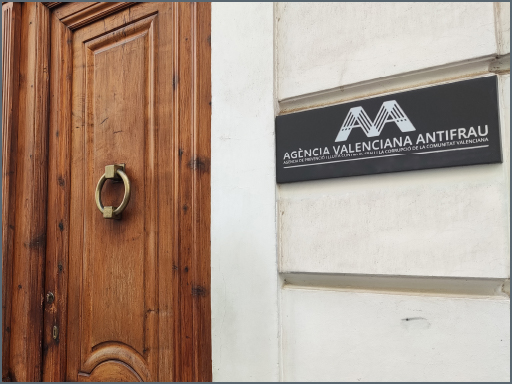
The event took place at the headquarters of the Valencian Anti-Fraud Agency, which welcomed the award recipients and expressed its gratitude for their commitment and actions. During his speech, the Agency’s director explained the purpose of these awards, emphasizing that whistleblowers often face high personal, family, and professional costs, especially in contexts where the reported irregularities generate resistance, misunderstanding among colleagues, and, at times, reprisals.


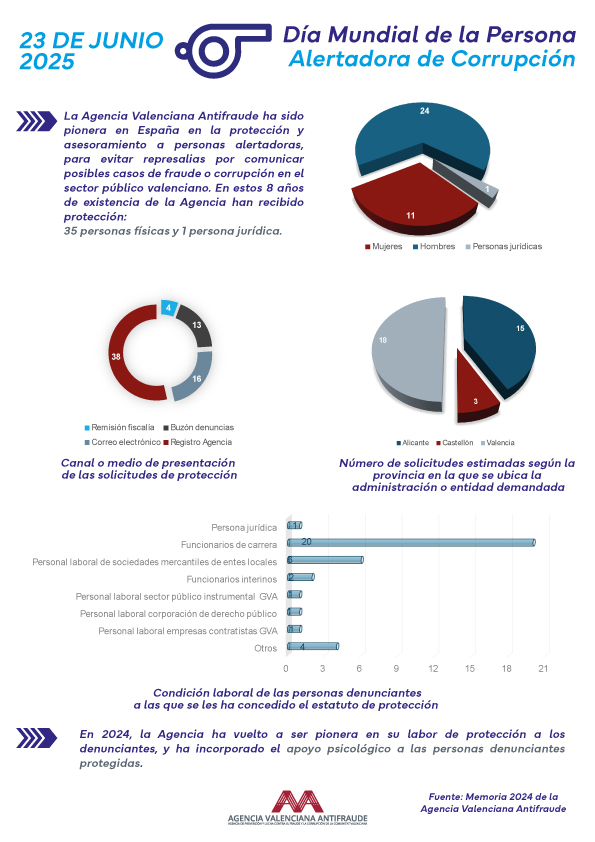
The director, Eduardo Beut, highlighted that, before the creation of bodies such as the Valencian Anti-Fraud Agency, whistleblowers did not have an effective system of institutional support. Likewise, Beut praised the work carried out by the Agency’s previous leadership and stressed that, since its establishment in 2016, 36 whistleblowers have been protected, with the institution being a pioneer in Spain in setting up specific mechanisms of protection and support for those who report irregularities in the public sector. The institution reiterated that, although the ideal scenario would be one in which no one needed protection because abuses or irregularities did not exist, as long as these persist, the Agency will continue to actively defend whistleblowers and publicly acknowledge their work.


During the event, Juan Antonio Vivar Piera, Chair of the Ethics Committee, not only highlighted the value of the whistleblowers’ actions but also explained that the AVAF Whistleblowing Awards are honorary in nature and aim to make visible the civic heroism of those who report wrongdoing, as well as to promote a culture of responsible reporting as a fundamental pillar of anti-corruption strategies, in line with the United Nations Convention against Corruption and European and Spanish legislation on whistleblower protection.


In this edition, the AVAF 2025 Whistleblowing Award: The Courage to Report was presented to two whistleblowers. Antonio Rico Bellido, who reported irregularities within the Local Police of his municipality and suffered workplace reprisals that severely affected his health, rights, and dignity. Despite this, he maintained his commitment to legality and public integrity. The Agency highlighted that, although he received institutional support, his personal resolve proved decisive in sustaining the complaint and enabling the investigations to move forward.


The award also recognized the bravery of Vicente Javier López Saborit, an environmental officer of the Generalitat Valenciana, for reporting the unlawful occupation of public land and the administrative inaction regarding these events. His perseverance and cooperation with the Agency made it possible to restore urban planning legality and protect public assets, which is why he was also awarded this year.


The event concluded with the explicit recognition by the Valencian Anti-Fraud Agency of the bravery of the award recipients, reaffirming the institution’s commitment to defending the public interest and the effective protection of those who report irregularities.


AVAF attends the EPAC/EACN Conference in The Hague, where the Declaration to strengthen anti-corruption cooperation in Europe is adopted

València, 2 December 2025.- The 24th Annual Conference and General Assembly of the European Partners Against Corruption (EPAC) and the European contact-point network against corruption (EACN) was recently held in The Hague (Netherlands), with the participation of the Valencian Anti-Fraud Agency (AVAF). This year, the conference was organised in cooperation with Eurojust. Following this year’s General Assembly, 7 new members joined the network, bringing the total to 126 European institutions from 40 countries.


AVAF was represented by Miguel Ángel Cervera, Secretary-General of the Agency, at a meeting that gathered more than 150 participants from nearly 80 institutions across more than 30 countries. Speakers included representatives from the European Commission, the Council of Europe, the European Public Prosecutor’s Office, Europol, Eurojust, OLAF, and various anti-corruption agencies and police oversight bodies from across Europe.


This event is one of the main European forums dedicated to the exchange of good practices in preventing and combating corruption, as well as in police oversight. During the meeting, the Hague Declaration was adopted, calling for greater institutional independence, enhanced cooperation, and renewed efforts to prevent and fight corruption throughout Europe.


The Conference focused on strengthening cooperation between anti-corruption and police oversight institutions, exchanging practical experiences, and addressing current challenges to promote integrity and transparency. Discussions covered key issues such as measuring and preventing corruption, transparency in public procurement, innovations in anti-corruption practices, education and awareness-raising, and the development of resilient institutions in post-conflict and transition contexts.


The Hague Declaration reaffirmed the shared commitment of European anti-corruption authorities and police oversight bodies to integrity, transparency, and the rule of law. It calls for greater institutional independence, professional standards, and international cooperation in the fight against corruption and in ensuring accountability. Members are encouraged to exchange good practices, strengthen cross-border collaboration, and ensure continuous professional development. States are urged to guarantee adequate resources, transparency in open data, and protection for prosecutors and investigators. The declaration also invites EU institutions and international organisations to reinforce common anti-corruption standards, provide technical assistance, and promote coherent and coordinated global efforts.


Information extracted from the EPAC/EACN press release:

https://epac-eacn.org/the-24th-epac-eacn-annual-conference-and-general-assembly-took-place-in-the-hague-netherlands/